
If you've got around $7,000 in credit card debt and a quiet voice telling you you'll never get out, I want to push back on that voice with actual numbers. Not "pay more than the minimum" advice, an actual 12-month plan with the real monthly payment it takes to clear an average balance. It's a bigger number than the minimum, but it's a finish line you can see, and that changes everything.
This is how to get out of credit card debt in a year for a typical household, the math, the milestones, the do-it-today first move, and an honest off-ramp for when a year isn't realistic. Let's get specific.
The number most Americans are climbing out from
Here's the balance to plan around. Credit card balances roll up to a national total near $1.25 trillion, tracked in the Federal Reserve's G.19 revolving-credit series, which works out to roughly $6,700 per household carrying a balance. So we'll build this plan on a $6,700 balance. If yours is higher, the method's the same, the payment just scales up.
And the interest is the real headwind. The average credit card APR has been running around 21 percent, the highest in years. At 21%, every month you carry that $6,700 costs you real money in interest before you've paid down a cent of principal. That's the drag we're going to beat.
Why the minimum payment keeps you stuck
The minimum payment is designed to keep you in debt, not to get you out. The CFPB explains that paying only the minimum can take years, in some cases decades, to clear a balance, because the minimum is set just barely above the monthly interest. You pay, the balance barely moves, and the next month you do it again. That's not you failing. That's the product working as built.
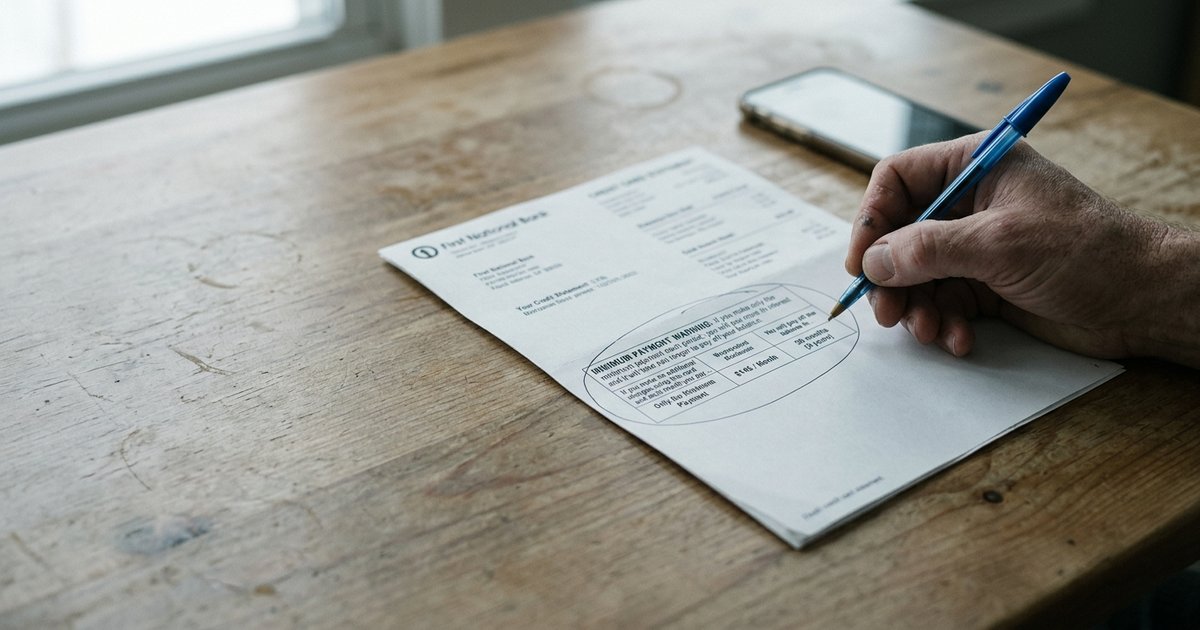
You can see this on your own bill. Thanks to the CARD Act, your statement has a box showing what you'd pay monthly to clear the balance in 36 months, and the total cost (CFPB, the 36-month box). Go look at it tonight. It's a built-in reality check, and it's the first number to compare against the plan below.
The 12-month math: what it actually takes
To pay off a $6,700 balance at 21% APR in 12 months, you need to pay about $624 a month. Over the year, that's roughly $7,486 total, meaning about $785 in interest. (These are computed by standard amortization on a $6,700 balance at 21%, assuming you stop adding new charges, your real numbers will vary with your rate and balance.)
Now compare that to the slower paths, because the contrast is the motivation:
- 12 months: about $624/month, roughly $785 in interest. Done in a year.
- 36 months (the CARD Act box): about $252/month, but roughly $2,386 in interest. You'd pay three times the interest to stretch it to three years.
- Minimum only: years, possibly decades, and far more interest, per the CFPB.
That's the trade in plain dollars. Paying $624 instead of $252 isn't easy, I'm not going to pretend it is. But it saves you well over a thousand dollars in interest and gets you free in 12 months instead of 36. If $624 is out of reach, that's fine, the milestones below and the off-ramp later still apply. Even landing between these numbers beats the minimum-only trap. Run your own balance through our debt payoff calculator to see your exact 12-month payment.
Month-by-month milestones
A year is easier to walk when it's broken into three stretches.
- Months 1 to 3, setup. Find your real APR, set the auto-payment at the highest amount you can sustain, and stop adding new charges to the card. This is the hardest stretch because the balance still looks big. Keep going, you're laying track.
- Months 4 to 9, momentum. The balance starts visibly dropping and more of each payment hits principal instead of interest. Roll any windfall, a tax refund, a bonus, a birthday check, straight onto the balance. This is where it gets satisfying.
- Months 10 to 12, finish. The balance is small enough that the end feels real. Don't coast, push the last stretch hard and clear it. Then redirect that $624 somewhere that builds you up instead of costing you.
Do this today: your first action
Three moves, and you can do all three before bed:
- Find your APR. It's on your statement or in your app. You can't plan around a number you don't know.
- Set the auto-payment as high as you can realistically sustain. Even if it's not the full $624, automate it so it happens without willpower.
- Stop adding to the balance. Take the card out of your wallet, out of your saved payment fields, whatever it takes. You can't bail out a boat while drilling new holes in it.
That's today's whole job. You don't have to feel free yet. You just have to know your number, automate a payment, and stop the bleeding.
Accelerators
Two tools can speed this up, with eyes open. A balance transfer card can park your balance at 0% for an intro window, which is powerful if you'll clear most of it before the regular rate kicks in, just mind the transfer fee and the date the promo ends, and know that approval and terms vary. And the order you attack multiple cards matters: our breakdown of snowball vs. avalanche shows whether to start with your smallest balance or your highest rate.
To pressure-test any of this against your real numbers, run them through the debt payoff calculator. It'll tell you your exact payment for a 12-month finish, and what a balance transfer or a bigger payment does to the timeline.
When a year isn't realistic
Sometimes the honest answer is that $624 a month doesn't fit your life right now, especially at today's higher APRs. That's not a verdict on you. It means a year was the wrong frame, not that you can't get out.
This is where nonprofit credit counseling earns its keep. A reputable nonprofit debt management plan can lower your interest rates and roll your payments into one, and the first counseling session is usually free. A counselor can see options you can't from the inside. One caution: keep nonprofit counseling separate in your mind from for-profit debt settlement, which is riskier, can hurt your credit, and may carry tax consequences. They are not the same thing. If consolidating into a single fixed payment would help instead, you can see what loan options may be available with no obligation.
After payoff: a small buffer so you don't slide back
When the card hits zero, do one thing before you celebrate too hard: send part of that freed-up $624 into a small emergency fund. The reason most people slide back into card debt isn't weakness, it's the next surprise expense with nothing to absorb it. A modest buffer is what keeps a flat tire from becoming a balance again, and it's how this stays a one-time climb instead of a loop. Pair it with a flexible 50/30/20 budget and the next hard month has somewhere to land.
Frequently Asked Questions
What monthly payment do I need to be debt-free in a year?
For an average balance of about $6,700 at 21% APR, you'd need to pay roughly $624 a month to clear it in 12 months, paying about $785 in interest along the way. Your exact figure depends on your balance and rate; a debt payoff calculator can pin it down.
Why does my balance barely move when I pay the minimum?
Because the minimum is set just above your monthly interest, so almost nothing goes to principal. The CFPB notes that paying only the minimum can take years or even decades to clear a balance. Your statement's 36-month box shows a faster payment to aim above.
How much interest does stretching payoff to three years cost?
On a $6,700 balance at 21%, a 36-month payoff runs about $252 a month but roughly $2,386 in interest, compared with about $785 in interest over 12 months. Stretching it out roughly triples the interest you pay.
Is a balance transfer worth it or is it a trap?
It can genuinely help if you'll pay off most of the balance during the 0% intro window, but watch the transfer fee and the date the promotional rate ends, and remember approval and terms vary. It's a tool, not a guarantee.
What if I can't afford the payment to finish in a year?
That's common and not a failure. Pay the most you can sustain, and consider a nonprofit debt management plan, which can lower your interest rates and offers a free first session. Keep it separate from for-profit debt settlement, which is riskier.

Need cash before payday?
Pick your amount and get matched with lenders in our network. It's free, secure, and there's no obligation.